What can a horse teach you that life cannot? Learning to ride as an adult is about far more than balance or technique. Through her journey with her mustang, True Haven, the author discovers that horseback riding is an exercise in patience, trust, self-awareness, and authentic leadership. Along the way, she explores the often-overlooked history of Black equestrian communities, the unique challenges of working with a wild mustang, and why it’s never too late to begin a relationship with horses. Whether you’re considering your first riding lesson or reconnecting with an old passion, this story is a reminder that some of life’s greatest teachers don’t speak—they simply respond to how you show up.
More than a story about horses, this article is an invitation to slow down and embrace the process of learning. It reminds readers that meaningful progress is rarely measured by speed, but by the trust we build, the presence we bring, and the relationships we nurture. For anyone curious about horseback riding, personal growth, or the enduring legacy of Black equestrian culture, this journey offers practical encouragement and a powerful perspective on what it means to keep learning at any stage of life.
Spring is when horses want to move.
After months of short days and heavy sky and the kind of rain that keeps everything close to the ground, May arrives, and something opens. The fields green up. The trail’s firm. The horses feel it before the rider does. They lift their heads differently. Their stride lengthens. There’s a readiness in them, a forward quality, that the season just seems to release.
And once spring unlocks these feelings and thaws out our spirit, that sensation is carried into the summer months, too.
I have been paying more attention to this than I used to. Because this year, for the first time in my adult life, I have my own horse.
Her name is True Haven. She is a mustang. And she is teaching me things I did not expect to need to learn.
What You Discover in the Saddle
Riding as an adult is humbling in a way that is hard to fully describe to someone who hasn’t tried it.
You think, going in, that the challenge will be physical. Staying balanced. Learning to post the trot. Keeping your heels down. All of those things are real, and they take time to build into the body. But the deeper challenge, the one that surprised me, is the communication.
“A horse does not read your intentions. She reads your body. The tension in your leg. The way you hold your shoulders. Whether your breathing is even or caught somewhere in your chest. A horse is, in every moment, receiving information about your emotional and physical state and responding to it.”
There’s no performance in the saddle. You can’t project confidence you don’t have. The horse knows immediately, and she tells you she knows, with the set of her ears, the clarity of her movement, or the quiet act of simply drifting attention away from you.
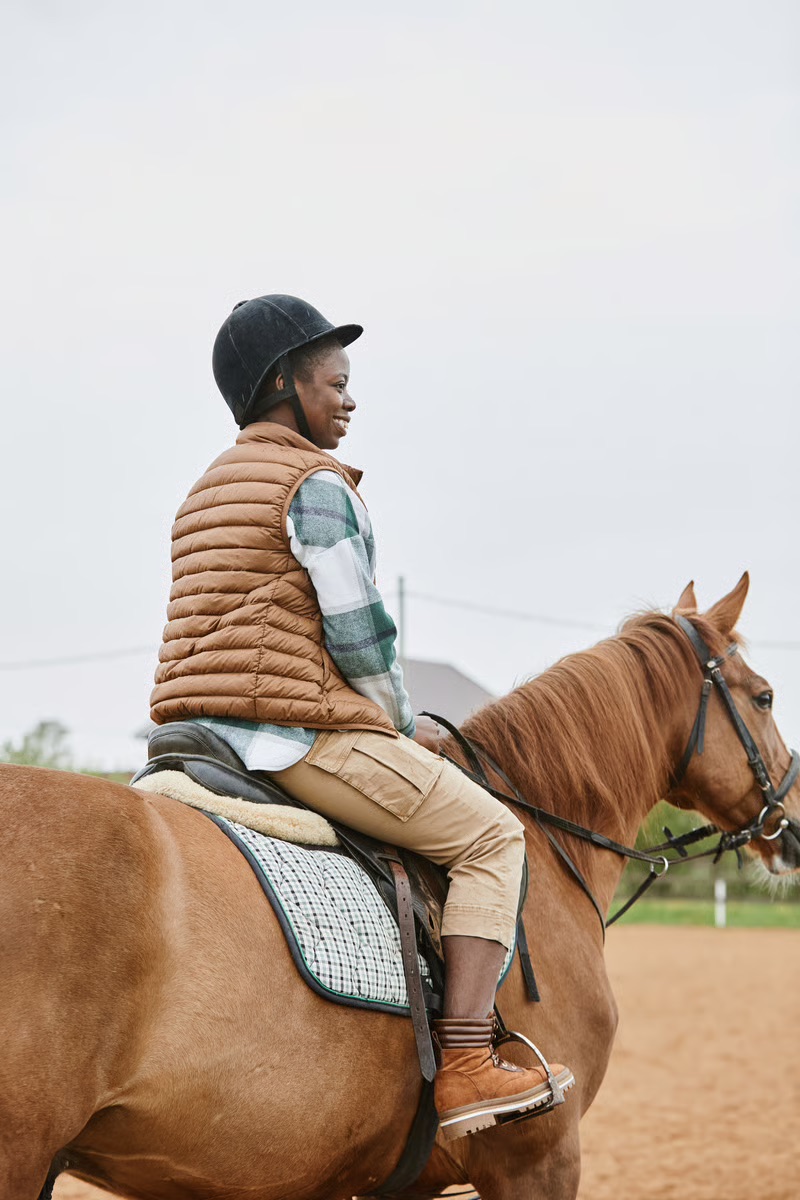
My lessons began with a horse named Cash, my trainer’s horse. Cash is calm and well-acquainted with new riders, and he proved to be a patient teacher. We have ridden together on the trail, where his steadiness gave me room to learn. On the trail, a horse becomes something else entirely: attentive, curious, ears working, taking in the world in ways you never will. True Haven and I are building toward that. The trail is where I want to take her when we are both ready. For now, that readiness is what we are working on, inch by inch, in the round pen, the arena, and the quiet mornings in her stall. There’s no shortcut to that kind of trust, and I’ve learned not to want one.
Learning to ride True Haven has required me to slow down in ways that feel unfamiliar. I have spent years building a practice around moving fast, holding many things at once, processing and deciding, and adjusting on the fly. The arena asks for something different. One horse. One moment. Sometimes the smallest gesture can set the agenda and mood that funnels down to the work we intend to do. The days when we are simply together, when I am fully present, and she is choosing to follow my leadership on a loose lead rope, are as important as the days when we accomplish something that looks like progress from an outside gaze.
There’s something else I didn’t anticipate: riding requires you to understand your own body before you can communicate anything to the horse. Where do you carry tension? Are you breathing from the belly or shallow in the chest? What happens to your balance when something surprises you? Do you grip harder or soften when you feel uncertain? The horse asks those questions without words, and the answers appear immediately in your whole body and mindset.
As a prey animal, a horse’s sense of danger can mean life or death. So if you, the human (and the predator species, I might add), are nervous, unpredictable, or aggressive, a horse can show anxiety or worse. They are, in the best possible way, a reflection of how you show up.
The Tradition Behind the Lesson
Every time I work with True Haven, I’m aware of how much history is behind this.
Black Americans have ridden, trained, and cared for horses for as long as there have been horses in North America. Many West and Central African cultures held horses in high regard, as symbols of leadership and mobility, as working partners in farming and trade, as animals whose care required a body of knowledge passed carefully from person to person.
When African people were brought to the Americas, much of that embodied knowledge came with them and became essential to the early American agricultural and ranching economy.
After Emancipation, that expertise continued in different forms: ranch work and rodeo, the riding clubs that formed wherever Black families settled and had access to land, the barns and stables where Black horsemen worked, taught, and kept the tradition alive without official recognition. The knowledge didn’t require institutions to survive. It moved through families, apprenticeships, and the simple act of one person showing another how to hold the reins.
In my book “Nature Swagger,” Virgil Baker writes about the Black riding community he found in the San Francisco Bay Area after years abroad: riders who had come from the South during the Great Migration, bringing their equestrian traditions with them. Weekend campouts. Fish fries on Friday nights. Long trail rides on Saturday mornings. Children growing up alongside horses, absorbing the rhythm of the work and the pleasure of it. That community expanded and contracted over the decades. Then it came back, larger, with young riders joining old-timers and the circle widening.
That’s the long thread I’m part of when I show up at the barn each morning and begin the patient work of building something with True Haven. The act of a Black woman choosing to learn to ride in middle age and to invest deeply in that relationship, to stay with it even when it’s frustrating and return to it because it’s joyful, is a continuation of something that stretches back a very long way.
The Mustang and What She Carries
True Haven is a mustang, which means she comes from the wild. Mustangs are descended from horses brought to North America by Spanish explorers centuries ago, and they have roamed the American West ever since. The Bureau of Land Management oversees the country’s wild horse and burro populations on public lands and makes horses available for adoption through its programs.
“Adopting a mustang isn’t a beginner’s project. Mustangs are intelligent, sensitive, and unaccustomed to the daily handling that domestic horses receive from birth. They require patience, consistency, and a willingness to work at the horse’s pace. That requirement, as it turns out, is exactly the teaching I needed.”
Working with True Haven has meant accepting that some days we will accomplish very little in a measurable way from an external perspective. My husband asked me daily, “Did you ride her yet?” but that was not the point, I explained, because first we had to build trust.
A kind of trust earned inch by inch, not through big moments, force, or urgency. The days when we’re simply together in the same space, me sitting in her stall reading a book without pressure or agenda, matter as much as the days with visible progress. The horse teaches the lesson the rider needs, not always the one she planned for.
There’s a particular morning I keep returning to in my mind. We were in her stall and paddock area, not doing any formal work, and True Haven walked toward me and just stood there, close enough that I could feel the warmth of her. It lasted about two minutes. Then she moved away. But those two minutes were earned. That’s how the trust builds, and that’s what I want when I think about what riding has given me.
A Growing Community
What gives me so much hope about this moment in Black equestrian life is the visibility.
Baltimore artist Bria Edwards has been documenting Black equestrian communities through figurative paintings and photographs, capturing the culture of historic horse clubs, including the Clinton Rough Riders, East Coast Rough Riders, and Commando Posse. Her work, featured in the Baltimore Beat, answers directly the question too many people have silently carried: there are Black people riding horses in this area. There always have been. The documentation is finally catching up to reality.
Social media has played its own role. Images of Black women on horseback, of Black families at trail rides and rodeos, of young Black riders competing in dressage, show jumping, and barrel racing, move through feeds in ways that felt exceptional a decade ago. Young people see those images and recognize something in them. They find lessons. They show up at community stables and riding clubs. They arrive with questions and, often, with a lineage of horse knowledge they didn’t know their families carried until they got into the saddle and something began to feel familiar.
Youth equestrian programs are growing. HBCUs have been building equestrian teams. The community of Black riders across the country is larger than it has been in generations, and it’s welcoming people in.
This spring, the 29th Annual Black Cowboy Festival brought riders, families, and fans of Black western heritage together in Rembert, South Carolina, from May 21 through 24. The festival features rodeo competitions, trail rides, live music, and four days of celebration rooted in a tradition that reaches back to the cattle drives and ranch culture of the 1800s.
What Beginners Should Know
If you’re thinking about learning to ride, or returning to it after years away, now is an excellent time to start.
The weather across most of the country is warm enough to be comfortable without being oppressive. Horses are generally more relaxed and forward in the warmer months, which makes them better teachers for beginners than the wary, cold-weather mindset of November. Many barns offer beginner lesson series in spring that run through summer, giving you enough time to actually build something before the season turns.
When choosing a barn, look for instructors who work at the student’s pace and communicate clearly about what to expect. Ask about the school horses, which animals are used for lessons, and what they’re known for in terms of temperament. A calm, forgiving horse can teach a beginner more than any amount of instruction alone. See if you can take part in grooming, such as brushing, cleaning hooves, and saddling, or tacking up. Doing this helps you to warm up. Ask to watch a lesson before you and the horse connect and warm up to the session. sign up.
Also, see how the environment feels when you walk in. Barn culture can vary widely, some more supportive and social than others, but there is usually a barn fit for anyone.
“You don’t need equipment to begin. Comfortable jeans that fit close to the leg, boots with a small heel and rubber bottoms (most western boots work fine), and a helmet. As you continue, you can build a wardrobe that fits your riding style and discipline. The priority in the first few months is simply showing up.”
Importantly, come with patience for yourself. You will feel uncoordinated. Your body will do things you didn’t ask it to do. The horse will know. But if you keep returning, something begins to settle. The muscle memory develops. The communication starts to form. There will be a moment, somewhere in the middle of an ordinary lesson, when the horse does exactly what you asked, and the response comes from connection rather than pressure. That moment is worth all the fumbling that comes before it.
It’s worth noting that riders of all backgrounds have found their way to horses later in life. The tradition is wide. Adult beginners are welcome at most good barns. And the people who have been riding for decades are often the most eager to share what they know, because they understand that traditions survive through teaching.
Come Find What the Horse Knows
As the riding season opens across the country, I want to extend an invitation to anyone who has been drawn to horses but hasn’t found the door yet.
The history of Black people in the saddle is long and rich and mostly untold at the mainstream level. The tradition is alive and growing. The barns and clubs and festivals are there, in more places than most people realize. True Haven has been one of the most challenging and rewarding things in my life this year, and I am only at the beginning of what she will teach me.
Frequently Asked Questions (FAQs)
1. Is it too late to learn horseback riding as an adult?
Not at all. Many people begin horseback riding later in life and find it to be both rewarding and transformative. Learning as an adult offers a unique opportunity to develop confidence, patience, body awareness, and communication skills while building a meaningful partnership with a horse.
2. What makes mustang horses different from other horses?
Mustangs are descendants of free-roaming horses that have lived in the American West for generations. Because they often have less human handling than domestic horses, they require patience, consistency, and trust-building. For many riders, working with a mustang becomes a journey of mutual respect and personal growth.
3. What is the history of Black equestrian culture in America?
Black equestrian traditions date back centuries, with deep roots in West and Central African horsemanship and significant contributions to American ranching, agriculture, rodeo, and horseback riding. Today, Black riding clubs, equestrian organizations, and cultural events continue to preserve and celebrate this rich heritage while welcoming new generations of riders.
4. What should beginners look for when choosing a horseback riding lesson program?
New riders should look for experienced instructors, calm and well-trained lesson horses, and a supportive barn environment that emphasizes safety, patience, and clear communication. A quality lesson program allows beginners to learn at their own pace while developing confidence both in and out of the saddle.